
Holocaust Handbooks, Volume PB9:
Treblinka – Forensically Examined
By: Germar Rudolf
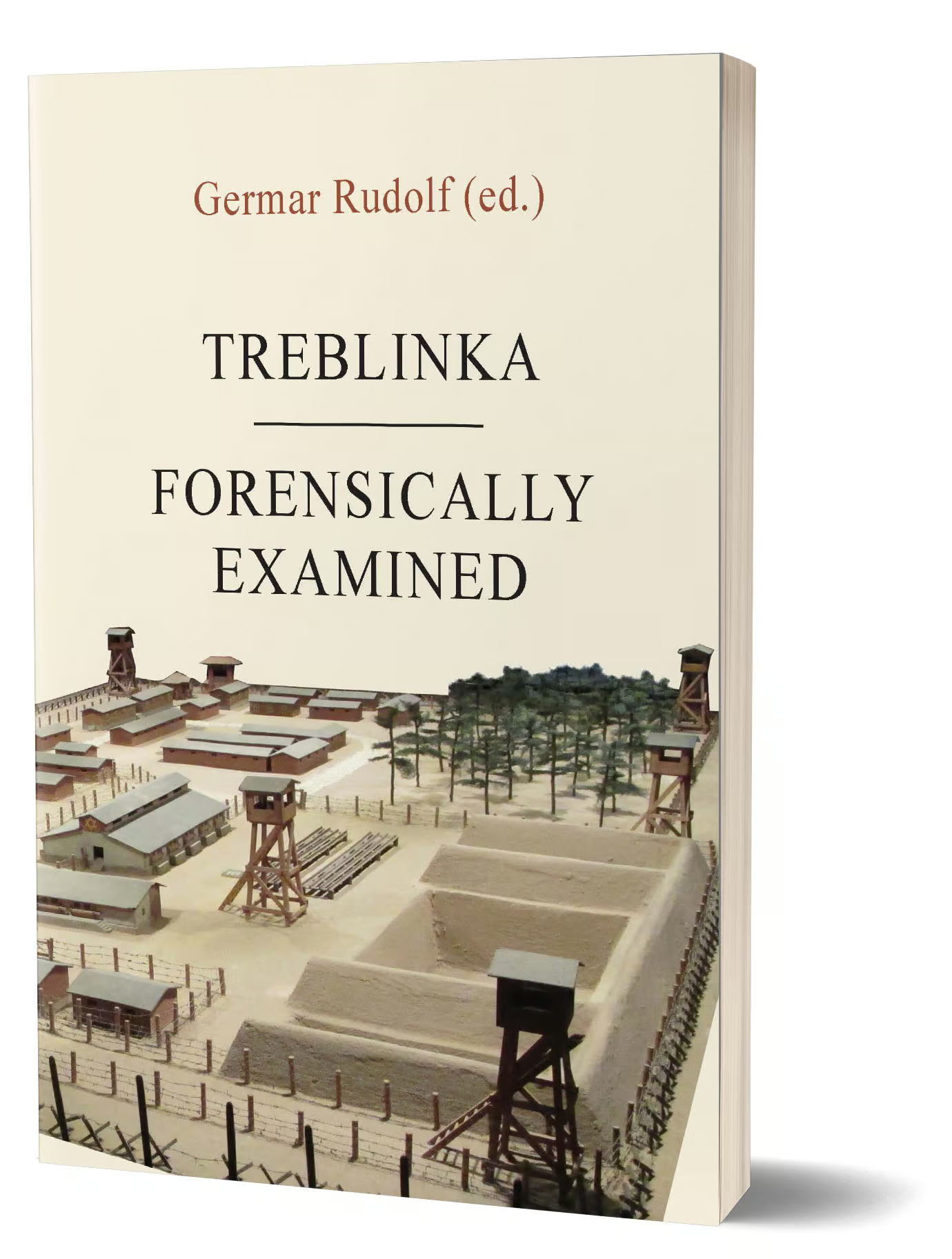
| Item Properties | |
|---|---|
| Published by: | Geneva, NY: FR Services |
| ISBN: | 978-1-971021-94-2 |
| Pages: | 166 |
| Size: | 8×5 |
| Edition No.: | 1 |
| Release Date: | 11/2026 |
| Illustrations: | 12 b+w |
| Features: | Index, Bibliography |
Treblinka was a WWII camp on Polish soil to which German occupational authorities deported between 700,000 and one million Jews during the years 1942 and 1943. Almost all of them are said to have been murdered there on arrival, and then buried in mass graves. The alleged murder methods vary (steam, vacuum, electrocution, exhaust gases etc.), but mainstream historians have settled on Diesel-engine exhaust. In 1943, the victims were presumably exhumed and burned on huge wood pyres within four months.
A mass slaughter of such gigantic proportion would have inevitably left plenty of traces that forensic science could detect during crime-scene investigations: massive volumes of disturbed soil layers of former mass graves; soil mixed with ashes, unburned wood and human remains; lost or discarded items by captors and captives; traces of former buildings, fences, wells and so on.
There have been three attempts to find such traces: two rather superficial ones right around war’s end by Soviet and Polish authorities, and a more-detailed attempt between 2010 and 2019 by a British team led by Dr. Caroline Sturdy Colls. The latter published the results in a 480-page book in mid-2026.
The present study critically examines those results. Six contributions by five different authors examine various aspects of the Treblinka Camp and its forensic examination. The first paper by Germar Rudolf summarizes the information we have to date about Treblinka. Papers by Dr. David Skrbina, Thomas Olson and Carlo Mattogno, each with a different approach, pick apart Dr. Sturdy Colls’s book, exposing it as “archaeologically and historically inconsistent and utterly devoid of any scientific value” (Mattogno). In a paper on the “Chemistry of Treblinka,” Germar Rudolf describes what a proper chemical forensic analysis would look like, juxtaposing it to the amateurish approach of Sturdy Colls’s team. The final paper by Muhammad Amin introduces the growing body of documental evidence pointing to an entirely different, non-lethal role of the Treblinka Camp: a transit camp for Jews sent further east.
You can buy this book here: 
This book’s PDF file on Archive.org: (in case mainstream sites block or ban links to our site)
Download Options:


